
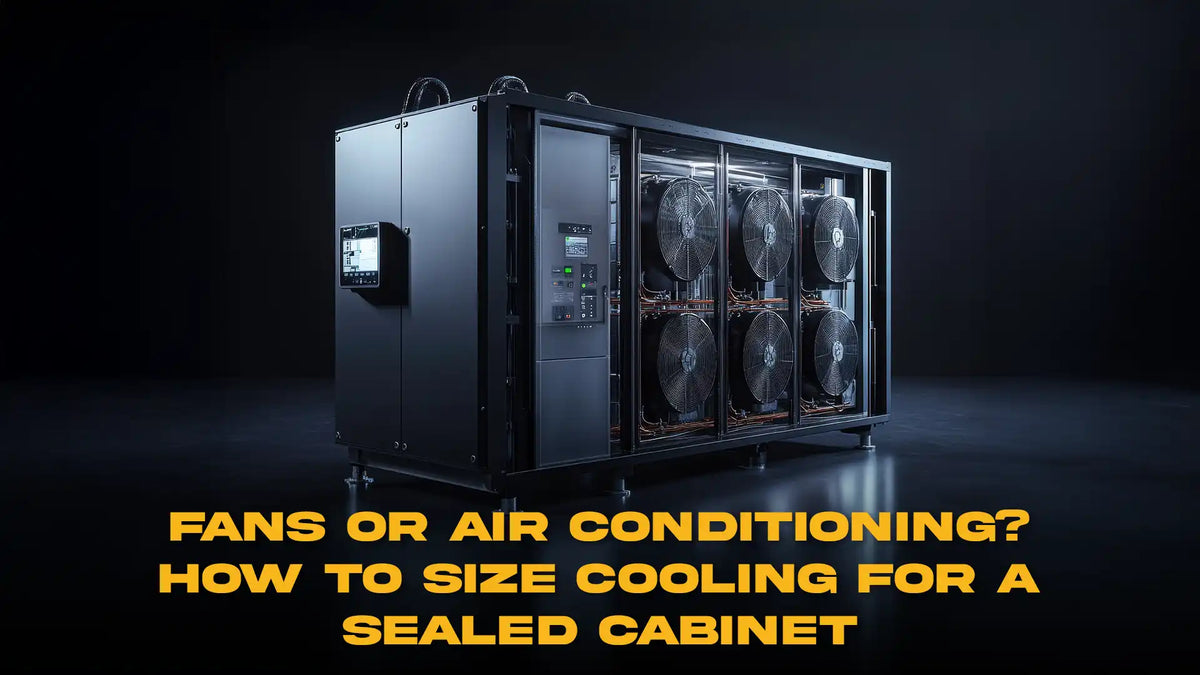
Heat is the quiet killer of field equipment. An enclosure heat load calculation takes maybe ten minutes on paper and prevents the kind of failure that shows up at two in the morning in July.
Most people skip it. They buy a cabinet, notice it runs warm, bolt on a fan and hope. Sometimes that works. In a sealed outdoor box under Texas sun, it very much does not, and no enclosure heat load calculation would have suggested it would.
The Two Numbers Behind Every Enclosure Heat Load Calculation
Cooling design comes down to how much heat your equipment makes and how much hotter the inside can be than the outside.
Watts to BTU Conversion
Every watt your gear consumes turns into heat. The watts to btu conversion is simple arithmetic, since one watt equals about 3.41 BTU per hour.
A cabinet with a 200 watt switch, a 60 watt firewall and a 40 watt modem carries 300 watts of load, which the watts to btu conversion turns into roughly 1,023 BTU per hour of heat that has to go somewhere.
Add power supply inefficiency and the real number climbs a little higher. Rounding up is the safe habit here.
Delta T Enclosure Cooling
The second number is temperature difference. Delta t enclosure cooling describes how many degrees you need between the inside of the cabinet and the ambient air outside it.
If your equipment tolerates 104 degrees Fahrenheit and the hottest summer afternoon reaches 100, your working delta is four degrees. That is almost nothing, and it is where passive and fan based solutions quietly fall apart. Every delta t enclosure cooling conversation starts with local ambient records, not with product brochures.

Fan vs Air Conditioner Cabinet Decisions
Here is the rule that settles most arguments. The fan vs air conditioner cabinet choice depends entirely on whether outside air is cooler than your target inside temperature.
Fans move air. They cannot make air colder. If ambient hits 100 and your target is 95, no fan on earth will get you there.
An air conditioner or thermoelectric cooler actively removes heat, so it works regardless of outside temperature. It costs more, draws more power, and needs condensate handling, but in hot climates the fan vs air conditioner cabinet debate ends quickly.
Filtered Fan Limits
Fans have honest boundaries. Filtered fan limits include a maximum practical delta of roughly 9 to 15 degrees Fahrenheit above ambient, and that assumes clean filters and unobstructed airflow.
Dust changes everything. A filter at half capacity can cut airflow enough to push internal temperature up 15 degrees on its own, which is why filtered fan limits get worse over time rather than staying constant. Filters also mean the cabinet is no longer sealed, so an IP66 rated box with a vented fan is not IP66 anymore.

Sealed Cabinet Cooling Options
When the box has to stay closed, the options narrow. Sealed cabinet cooling means moving heat across a barrier rather than exchanging air.
-
Air to air heat exchangers move heat through a plate or pipe system while keeping the two airstreams separate.
-
Compressor based air conditioners and thermoelectric coolers actively pull heat out and reject it outside.
Sealed cabinet cooling costs more up front and pays for itself the first time a dust storm or a sideways rain event rolls through a site.

Running the Enclosure Heat Load Calculation
A basic btu cooling calculator enclosure worksheet has four inputs.
Total equipment wattage, converted to BTU per hour. Maximum ambient temperature at the site. Maximum allowable internal temperature. Cabinet surface area and material, since a painted steel box radiates a modest amount of heat on its own.
Feed those into any btu cooling calculator enclosure tool, or into a manufacturer sizing chart, and you get a required cooling capacity. Then add a safety margin of about 20 percent, because solar gain on a metal box in direct sun is real and it is bigger than most people expect.
Solar Gain Deserves Its Own Line
A dark cabinet in full sun can run 30 degrees hotter than shaded ambient before the equipment inside contributes anything at all. Sun shields, light colored finishes and double wall construction all shave that number down.
Why This Is Getting Harder
Equipment density keeps climbing. Industry reporting through 2026 notes that conventional server racks once sat between 5 and 15 kilowatts, while AI focused racks now routinely exceed 300 kilowatts, and cooling already accounts for roughly 40 percent of data center energy use.
Edge sites are smaller but the trend is the same. More compute at the pole, more heat in a box that has no building around it.
Thermal Management Outdoor Cabinet Design
Good thermal management outdoor cabinet planning stacks several ideas rather than relying on one.
An enclosure heat load calculation tells you the size of the problem, and these choices shrink it. Mount the cabinet out of direct afternoon sun where possible. Choose double wall construction in hot climates. Place hot equipment high and cool intake low. Keep cable bundles from blocking airflow paths, since a wall of cables behind the rails acts like insulation.
Sensible thermal management outdoor cabinet design also includes a thermostat, so fans or coolers run when needed rather than constantly, and a temperature alarm so you find out about a failure before the equipment does.
Do Not Forget Cold
Heating gets ignored until it matters. Below freezing, batteries lose capacity, LCDs fail and condensation forms as temperatures swing. Combination units that cool, heat and dehumidify solve all three in one box, which is why Sturdx and similar manufacturers list them alongside plain coolers.
A Worked Example
Say a site carries 400 watts of equipment. That is about 1,364 BTU per hour. Ambient peaks at 100 degrees, equipment tolerates 95 degrees internal.
Delta is negative, so fans are out immediately. The enclosure heat load calculation points straight to active cooling sized above 1,364 BTU per hour, then bumped by 20 percent for solar gain, landing near 1,650 BTU per hour minimum.
Compare that to a shaded site with 150 watts of load and a 110 degree equipment tolerance. Same math, completely different answer, and a filtered fan module handles it fine.
The Takeaway
Do the enclosure heat load calculation before you shop, not after the first failure. Convert watts to BTU, check your real ambient highs, find your delta, and let the numbers pick the hardware.
An enclosure heat load calculation done honestly costs you ten minutes. Skipping it costs a site visit, and probably a switch.



Dejar un comentario
Este sitio está protegido por hCaptcha y se aplican la Política de privacidad de hCaptcha y los Términos del servicio.