
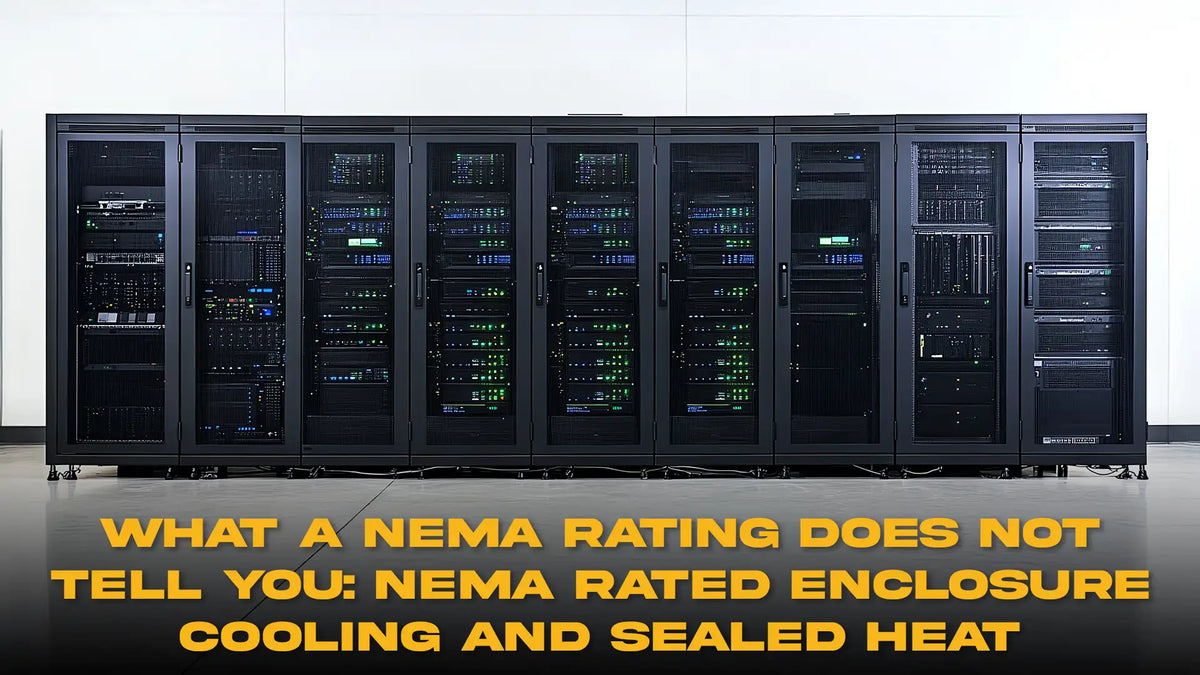
There is a failure mode that looks like bad luck and is actually a specification gap. A switch inside a properly sealed Type 4X cabinet stops responding on a hot afternoon, everything is dry inside, the gaskets are perfect, and the problem turns out to be NEMA rated enclosure cooling that was never designed in the first place.
The rating did its job. It kept water, dust, and corrosive air out of the box. What it never promised was NEMA rated enclosure cooling, and a sealed enclosure has no way to release the heat its equipment produces on its own.
The Rating Describes Ingress, Not Temperature
NEMA 250 defines protection against dust, rain, sleet, hose directed water, ice formation, oil, coolant, and corrosion. Read the type definitions carefully and one word never appears in a way that helps you: temperature. External ice formation is addressed, ambient heat is not.
This creates a genuine paradox. The better the enclosure seals, the worse it dissipates. A Type 1 indoor cabinet with ventilation openings breathes. A Type 4X stainless enclosure with continuous gasketing does not, and that same sealing quality is what turns it into a small oven when the sun hits it. Better sealing raises the NEMA rated enclosure cooling requirement rather than lowering it.

Sturdx treats NEMA rated enclosure cooling as part of the enclosure design rather than an accessory chosen later, because the two decisions are physically inseparable.
Two Heat Sources, One Sealed Box
The sealed enclosure heat load has two components and both need to be counted.
The first is internal dissipation. Every watt drawn by equipment inside the cabinet becomes heat, with almost no exception. A PoE switch feeding twenty four cameras, a small UPS, and a recorder can easily produce three to five hundred watts continuously.
The second is solar gain. A dark enclosure in direct sun absorbs a substantial thermal load through its roof and its sun facing wall, and on a clear summer day that contribution can rival the equipment inside it. Interior temperatures in unshaded outdoor cabinets routinely run well above ambient before anything is switched on.
Add the two together, compare the result against the maximum operating temperature of the least tolerant device inside, and the sealed enclosure heat load answers the cooling question for you.
Choosing a Thermal Approach
|
Approach |
Rating impact |
Typical capacity |
Best suited to |
|
Passive dissipation |
None |
Under 100 W |
Light loads, shaded locations |
|
Filtered ventilation |
Reduces sealing |
100 to 400 W |
Clean air, mild climate, indoor use |
|
Air to air heat exchanger |
None, seal preserved |
200 to 800 W |
Outdoor sites where ambient is cooler |
|
Closed loop air conditioner |
None, seal preserved |
500 W and above |
High loads, hot climates, dense equipment |
|
Thermostatic heater |
None |
Not applicable |
Freezing climates, condensation control |
The important column is the second one. Adding louvers or a filtered fan to a Type 4X cabinet does not degrade it slightly, it invalidates the rating entirely, because the enclosure is no longer sealed against the ingress it was tested for.
An enclosure heat exchanger avoids that outcome by moving heat across a barrier without exchanging air. Two separate circuits, one internal and one external, pass over opposite sides of a conductive core. Nothing from outside enters the cabinet, and an enclosure heat exchanger is the default solution for sealed outdoor housings.

Where the outside air is too hot to help, a NEMA 4X air conditioner becomes necessary. A NEMA 4X air conditioner is a compressor based unit built into the door or side panel, rated in BTU per hour, and specified to match the calculated heat load with headroom for the hottest day of the year rather than an average one.
Does a NEMA Rating Include Temperature Protection
Asked directly, does a NEMA rating include temperature protection, the answer is no in every practical sense.
Type definitions address external ice formation, which is a mechanical concern about the enclosure remaining operable when covered in ice. They say nothing about maintaining an internal temperature band, and they impose no requirement on the manufacturer to provide cooling or heating.
This has a real consequence for procurement. A quote for a Type 4X enclosure and a quote for one with NEMA rated enclosure cooling describe different products at very different prices, and comparing them side by side without noticing the difference is a common and expensive mistake.
Condensation Is the Other Half of the Problem
Cooling is only one direction of travel. The reverse case damages equipment just as effectively.
Warm humid air sealed inside a cabinet during a hot afternoon will deposit moisture on internal surfaces when the enclosure cools rapidly overnight. The mechanism is the dew point, the temperature at which air can no longer hold its water vapor, described clearly in the reference material on dew point. Nothing has leaked. The water was already inside, carried by the air.
The remedy is temperature control rather than better sealing. A thermostatically or hygrostatically controlled heater keeps critical surfaces above the dew point during cool hours, and it is a standard part of thermal management NEMA enclosure design in any climate with a meaningful day to night temperature swing.
A cabinet can be perfectly waterproof and still be wet inside. Sealing keeps rain out, it does not keep physics out.
Shade Before Cooling
The cheapest watt of cooling is the one you never have to remove.
A sun shade for outdoor enclosure installations, meaning a second roof and often a shading panel on the sun facing wall, creates an air gap that carries solar heat away by convection before it reaches the enclosure skin. A sun shade for outdoor enclosure work has no moving parts, needs no power, and cannot fail in service.

Light colored or reflective finishes work in the same direction, though they trade off against appearance and against the corrosion performance expected from certain coatings. Orientation matters too. Where site conditions allow, placing the door away from the afternoon sun reduces both the thermal load and the discomfort of servicing the cabinet at the hottest hour.
Sizing and Monitoring
Closed loop cooling for outdoor cabinets should be sized against a worst case rather than a typical day. Total the internal dissipation in watts, add an allowance for solar gain based on shading and orientation, define the maximum acceptable internal temperature, and compare that against the highest ambient the site will see. The gap between those numbers determines the required capacity.
Then monitor it, because closed loop cooling for outdoor cabinets fails quietly. A sealed enclosure hides its own failures well, and a fan that stopped six weeks ago or a filter that clogged in spring will not announce itself until equipment shuts down. A temperature sensor reporting to the network management system converts an outage into a maintenance ticket, which is the entire point.
Sturdx specifies NEMA rated enclosure cooling against the customer's stated heat load and site conditions, and provides the technical documentation needed to verify the choice before installation rather than after.
Frequently Asked Questions
Does a NEMA 4X rating mean the enclosure is temperature controlled?
No. The rating covers ingress and corrosion only. NEMA rated enclosure cooling has to be specified separately as part of the enclosure design.
Can I add a ventilation fan to a sealed NEMA enclosure?
Not without losing the rating. Cutting a vent into a Type 4 or 4X body breaks the seal it was tested with. Use an enclosure heat exchanger or a closed loop air conditioner instead, which is how Sturdx configures sealed outdoor units.
How do I calculate the cooling capacity I need?
Add the wattage of all installed equipment, add an allowance for solar gain if the cabinet is outdoors and unshaded, then size the cooling device against the difference between your maximum acceptable internal temperature and the highest expected ambient temperature.
Why is there water inside a cabinet that has never leaked?
Condensation. Humid air trapped inside deposits moisture when internal surfaces fall below the dew point overnight. A controlled heater is standard practice in thermal management NEMA enclosure design, and additional sealing does not help.
Is a sun shade worth adding?
Usually yes for outdoor installations. It removes a meaningful portion of the heat load with no power draw and no maintenance, which often reduces the size of the cooling unit required.


Dejar un comentario
Este sitio está protegido por hCaptcha y se aplican la Política de privacidad de hCaptcha y los Términos del servicio.