
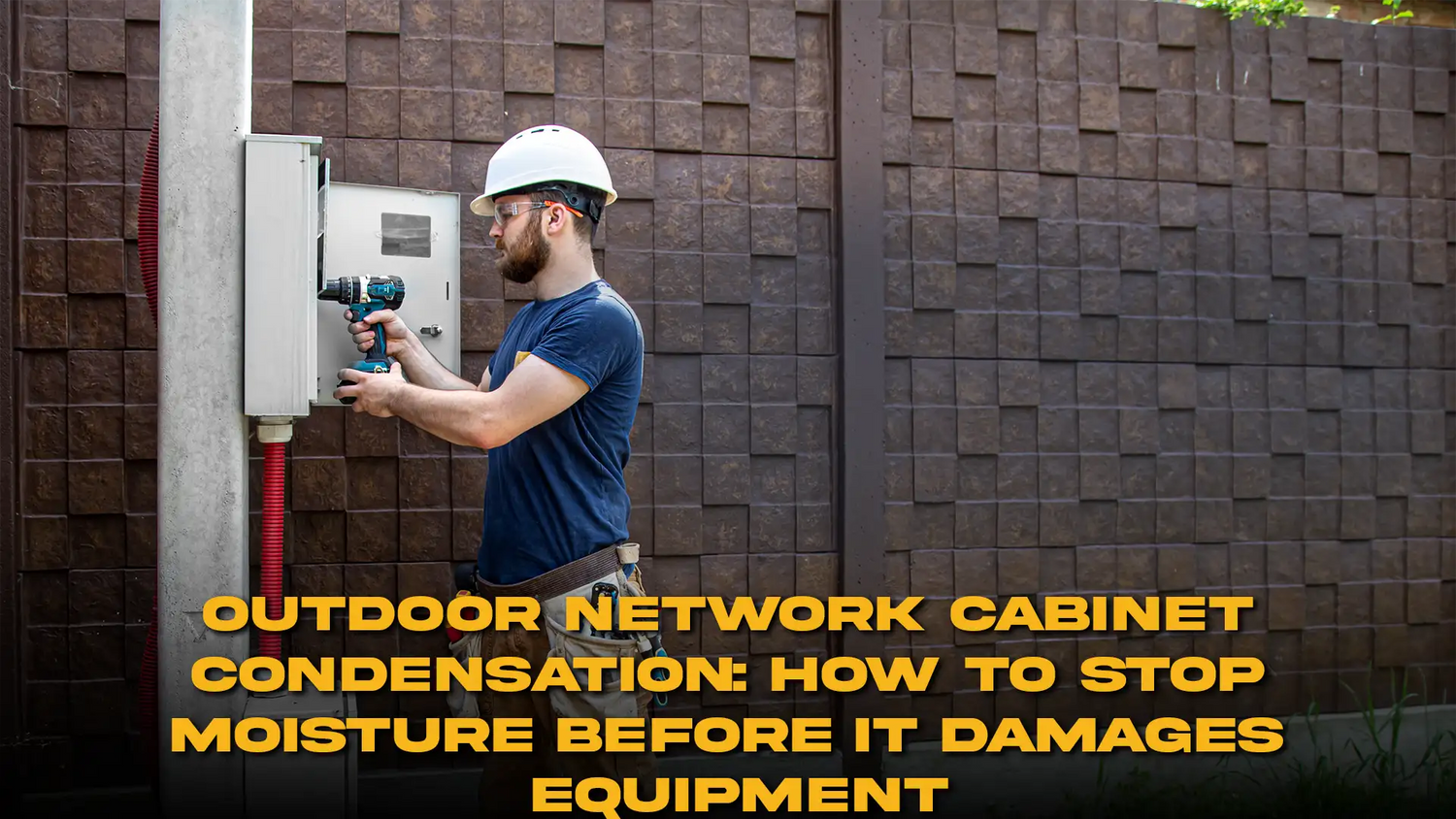
Outdoor networking is moving farther from climate-controlled rooms and deeper into parking lots, rooftops, factories, transportation sites, farms, campuses, and remote telecom locations. That shift is useful, but outdoor network cabinet condensation is becoming a quiet reliability problem because a sealed-looking cabinet can still develop water droplets without a visible leak.
The issue often appears after a cold night, a sudden warm morning, or repeated temperature swings. A cabinet may look perfectly dry during installation and show corrosion months later. For network teams, that is frustrating because switches, power supplies, fiber equipment, and surveillance hardware can fail even when rain never enters the enclosure.
Why a Weatherproof Cabinet Can Still Become Wet Inside
A weather rating describes protection from outside conditions, but it does not guarantee that internal air will always stay dry. The most common cause of network cabinet moisture is humid air trapped inside the enclosure and then cooled below its condensation point. The same process happens when water forms on a cold drink, except the electronics inside a cabinet are far less forgiving.
This is why dew point inside electrical enclosure calculations matter. Dew point is the temperature at which air can no longer hold all of its water vapor. When a cabinet wall, mounting plate, or metal component falls below that temperature, droplets can form. The cabinet is not necessarily leaking; the air itself is creating the water.
The First Warning Signs Are Often Easy to Miss
Early signs of outdoor network cabinet condensation can be subtle. Light fogging on a viewing window, tiny beads on the lower panel, oxidation around screws, pale residue near terminals, or a musty smell can all signal a developing problem. Intermittent communication faults may also appear before obvious corrosion is visible.
Technicians sometimes react by tightening every gland and door latch. That is reasonable when water ingress is suspected, but it will not solve a humidity problem by itself. Effective enclosure humidity control starts by identifying whether the source is external water, internal condensation, or both.
Practical Ways to Reduce Internal Condensation
The best answer to how to prevent condensation in outdoor enclosure installations is usually a layered approach. No single accessory fixes every climate. The enclosure location, heat load, local humidity, solar exposure, equipment duty cycle, and service frequency will all affect the final design.

Keep the Interior Slightly Warmer Than the Condensing Surface
An anti condensation heater for enclosure applications keeps critical internal surfaces above the dew point during cool periods. The heater does not need to make the cabinet hot. Its job is to create a small thermal margin so water vapor is less likely to turn into liquid on metal surfaces.
A thermostatic or hygrostatic control will improve this approach because the heater will operate when conditions require it instead of running continuously. In colder climates, an outdoor enclosure heater can also stabilize temperature during nights when active network hardware produces little heat.
Control Air Exchange Instead of Ignoring It
Some applications benefit from controlled ventilation or pressure equalization. Others need a sealed thermal system with cooling. The correct choice depends on outdoor contaminants as much as temperature. A dusty industrial yard and a clean sheltered campus should not automatically use the same strategy.
For serious IP66 cabinet condensation concerns, randomly drilling ventilation holes is a poor fix because the modification may compromise the protection level the enclosure was selected to provide. Purpose-designed vents, exchangers, filtered systems, air-conditioning units, or pressure equalization devices are safer choices when air exchange is required.
Good enclosure humidity control also means keeping wet cable jackets, packaging material, and cleaning residue out of the cabinet during commissioning. A surprisingly small amount of trapped moisture can remain inside for a long time if the enclosure is later closed tightly.
Cable Entries Can Decide Whether the Cabinet Stays Dry
Cable routing deserves more attention because water can travel along a cable even when the gland itself appears secure. Drip loops will help direct rainwater away from entries before it reaches the cabinet wall. Bottom entry is often easier to protect than top entry, although each installation has physical constraints.
Teams trying to prevent moisture in electrical enclosure installations should also seal unused entries correctly and use cable glands matched to cable diameter. Oversized glands, poorly compressed seals, or improvised filler can create paths for humid air and liquid water.
Thermal Management Has to Match Equipment Heat
Outdoor network cabinet condensation is only one half of the climate problem. A cabinet that is kept too warm can protect against moisture but overheat switches, power supplies, batteries, or surveillance devices. Thermal design therefore has to manage both low-temperature condensation risk and high-temperature heat rejection.
This is where an outdoor enclosure heater and a cooling method may work as complementary systems rather than competing ideas. The heater supports cold, damp periods; fans, heat exchangers, or air conditioning support hot periods. The controls should prevent those systems from fighting each other.

What About IP66 Enclosures?
A high ingress rating is valuable when rain, windblown dust, washdown, or harsh outdoor exposure is present. However, IP66 cabinet condensation can still occur because ingress protection and condensation prevention describe different mechanisms.
The phrase how to prevent condensation in outdoor enclosure installations sounds like a narrow maintenance question, but it is really a design question. Decisions made before deployment will usually be more effective than emergency fixes after corrosion begins.
A Simple Field Checklist Before Closing the Door
Technicians should also document normal temperature and humidity ranges when possible. A compact sensor can reveal patterns that a one-time service visit will miss. If the dew point inside electrical enclosure conditions repeatedly approach internal surface temperature, the design needs more margin.
For locations with persistent humidity, an anti condensation heater for enclosure use case may be one part of the answer, but monitoring will show whether additional changes are needed. Desiccants can assist in some small or temporary applications, yet they should not be treated as a permanent substitute for proper environmental design when moisture loads are continuous.

The Reliability Payoff Will Be Bigger Than the Fix Looks
A careful plan to prevent moisture in electrical enclosure installations will combine the right enclosure, controlled cable entry, appropriate thermal management, and periodic inspection. Sturdx cabinets can provide the physical platform, while the installation strategy will determine how well that platform performs in the real environment.
Outdoor network cabinet condensation will never be solved by one universal trick. But when temperature, humidity, sealing, heat, and service practices are treated as one system, the cabinet will stay far more stable. That is the difference between weather resistance on a specification sheet and dependable network protection in the field.
Recurring network cabinet moisture should be treated as a system warning, not a cosmetic annoyance. When outdoor network cabinet condensation keeps returning, the installation needs another look because the moisture source or thermal balance is still unresolved. Those small warning signs is easy to dismiss, but they often arrive before a larger failure.


Leave a comment
This site is protected by hCaptcha and the hCaptcha Privacy Policy and Terms of Service apply.